How commercial kitchens assemble, portion, and prepare sandwiches for safe, efficient delivery across the United States.
Before a sandwich ever reaches a delivery bag, it passes through a carefully choreographed kitchen preparation system. In the United States, commercial kitchens that prepare food for delivery must adhere to federal FDA food safety guidelines as well as state and local health department regulations. The preparation process is not simply about assembling ingredients — it is a logistical and food-science operation designed to maximize freshness, minimize contamination risk, and ensure every item delivered matches expected quality standards.
Key Principle: Preparation efficiency directly impacts delivery quality. Kitchens that optimize their assembly workflow reduce production time, minimize ingredient waste, and deliver more consistently fresh sandwiches to end customers.
Ingredient assembly is the structured process by which individual components of a sandwich are sourced, stored, prepared, and combined in a defined sequence. Every element — from the bread to the condiments — has specific handling requirements that must be respected to ensure food safety and flavor integrity.
Commercial sandwich kitchens in the USA typically source ingredients from licensed food distributors who comply with USDA and FDA standards. Proteins such as turkey, ham, and roast beef must be stored at or below 40°F (4°C) to prevent bacterial growth, in accordance with USDA Food Safety and Inspection Service (FSIS) guidelines. Dairy products — particularly cheeses — require similar temperature-controlled storage environments.
Fresh vegetables, including lettuce, tomatoes, cucumbers, and onions, must be washed in food-safe sanitizing solutions before use. Many high-volume sandwich kitchens use dedicated produce washing stations that incorporate chlorine-based or peracetic acid sanitizers approved by the EPA for food contact surfaces. Storage containers for prepped vegetables are typically labeled with prep dates and discard times to enforce FIFO (First In, First Out) rotation.
Bread and baked goods present their own storage challenges. Rolls and sliced breads are best kept in temperature- and humidity-controlled environments to prevent staleness or mold growth, particularly in humid US regions. Many kitchens receive fresh bread deliveries twice daily from local bakery suppliers to ensure maximum freshness for delivery orders.
Before the assembly line begins operating, kitchen staff complete a series of mise en place tasks — a culinary term for having every ingredient measured, prepped, and organized before service begins. For sandwich delivery operations, this typically includes slicing deli meats to consistent thicknesses using calibrated commercial slicers, portioning cheese slices by weight, washing and spin-drying leafy greens to prevent excess moisture from softening bread during transit, and slicing tomatoes, onions, and other vegetables to standardized thicknesses.
Condiments such as mayonnaise, mustard, and specialty sauces are loaded into squeeze bottles or portion-controlled dispensers to ensure consistent application across every sandwich. This standardization is particularly important in high-volume delivery kitchens where dozens or hundreds of sandwiches may be prepared simultaneously during peak hours.
Allergen management is another critical component of pre-assembly preparation. US kitchens are required under the Food Allergen Labeling and Consumer Protection Act (FALCPA) to identify and prevent cross-contact between common allergens — including wheat, dairy, eggs, tree nuts, and shellfish. Separate utensils, cutting boards, and preparation zones are typically used for allergen-sensitive ingredients.
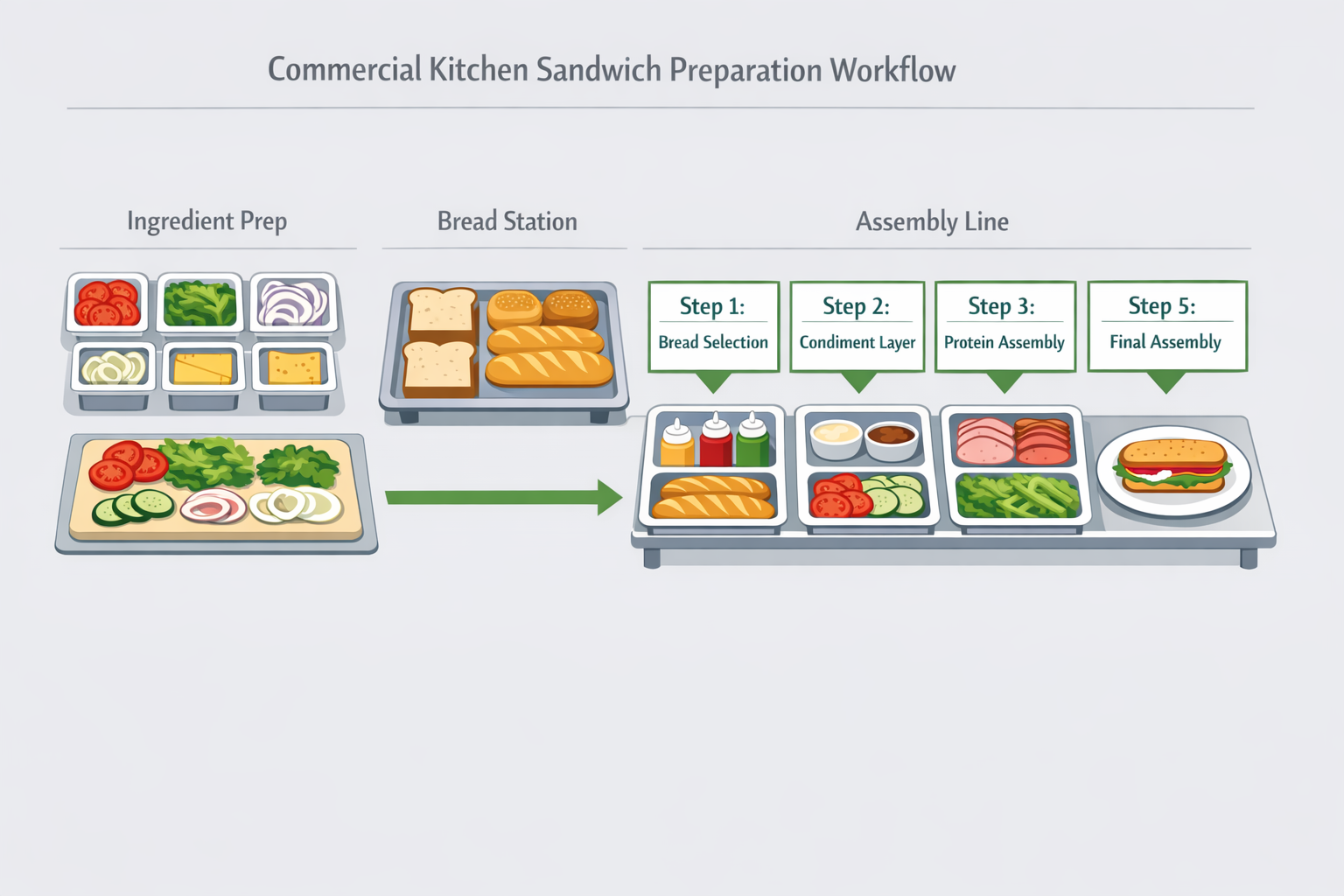
A well-designed sandwich assembly workflow follows a linear sequence that minimizes handling time while maximizing consistency. The following steps represent the standard assembly process used in delivery-focused commercial kitchens across the USA.
The assembly process begins with selecting the appropriate bread type for the order. Common options include hoagie rolls, ciabatta, sliced white or wheat bread, sourdough, and whole-grain options. The bread is inspected for freshness and, where appropriate, toasted or warmed using commercial conveyor toasters. Toasting has the dual benefit of enhancing flavor and creating a slightly firmer surface that resists moisture absorption from condiments and vegetables — an important consideration for sandwiches that may sit in packaging for 15–45 minutes before being consumed.
Condiments are applied to the interior surfaces of both bread halves using portion-controlled dispensers. Applying condiments before adding proteins and vegetables is standard practice — it creates a moisture barrier between the bread and wet ingredients, slowing the rate at which bread becomes soggy during transit. Common condiments include mayonnaise, Dijon mustard, yellow mustard, honey mustard, chipotle aioli, pesto, and oil-and-vinegar combinations. The type and quantity of condiment is typically determined by the standardized recipe, though custom modifications for individual orders are accommodated in made-to-order operations.
The protein layer — typically deli meats, grilled chicken, tuna salad, or plant-based alternatives — is placed on the bottom bread half after condiment application. Commercial kitchens portion proteins by weight (typically 3–6 oz per sandwich) using digital portion scales or pre-portioned stacks. Proper protein placement affects both the structural integrity of the sandwich and the customer's eating experience. Proteins are folded or layered to ensure even distribution across the full surface of the bread, preventing uneven bites and ensuring the sandwich holds its shape during packaging and transport.
Cheese slices are typically placed directly on top of the protein layer, where their fat content helps act as an additional moisture barrier between the protein and the fresh vegetables above. Fresh vegetables — lettuce, tomato, onion, cucumber, bell pepper, pickles — are then added in order of structural stability. Larger, firmer items such as tomato slices are placed lower in the vegetable stack, while lighter, leafy items like lettuce are placed at the top. Excess moisture is managed by using well-drained vegetables and, in some cases, placing a thin layer of lettuce as a buffer between wet vegetables and the top bread surface.
The top bread half is placed on the assembled sandwich and light pressure is applied to compress the layers into a cohesive structure. The sandwich is then cut — either diagonally or straight across — using a sharp, sanitized knife or an automatic sandwich press-and-cut machine used in high-volume operations. A final visual quality check is performed to verify that ingredients are evenly distributed, the sandwich is structurally sound, and the appearance meets presentation standards. At this point, the sandwich is ready to be passed to the packaging station for wrapping and preparation for delivery.
The physical layout and operational procedures of a delivery-focused kitchen have a direct impact on preparation speed, food safety, and order accuracy. Modern sandwich delivery kitchens are designed around flow efficiency and cross-contamination prevention.
Delivery-optimized sandwich kitchens follow a linear or parallel station layout that mirrors the assembly sequence. The production line flows in one direction — from ingredient storage and prep stations through assembly to packaging and dispatch — minimizing backtracking and cross-traffic. Each station is assigned a specific role, and staff are trained to maintain their station's cleanliness and ingredient inventory throughout the service period.
The cold rail or refrigerated prep table is the centerpiece of most sandwich kitchens. This piece of equipment maintains all prepped ingredients at safe temperatures (below 40°F) while keeping them readily accessible to assemblers. Ingredients are typically stored in 1/6 or 1/9 pan inserts arranged in the order they are used during assembly, allowing assemblers to build sandwiches in a single sweeping motion from one end of the rail to the other.
High-volume delivery kitchens use Kitchen Display Systems (KDS) — digital screens that receive orders from delivery platforms and display them to kitchen staff in real time. KDS technology eliminates paper ticket systems, reduces transcription errors, and allows kitchen managers to monitor order throughput, average preparation times, and error rates from a central dashboard.
Peak-hour demand management is one of the most challenging aspects of sandwich delivery kitchen operations. During lunch (11:00 AM – 1:30 PM) and dinner (5:30 PM – 8:00 PM) rushes, order volume can increase by 300–500% compared to off-peak hours. Successful kitchens manage this by pre-building high-demand items, staggering staff shift times to align with peak demand, and using predictive ordering systems that estimate ingredient usage based on historical order data and local demand patterns.
HACCP (Hazard Analysis and Critical Control Points) plans are maintained by most commercial sandwich kitchens operating in the USA, particularly those supplying food to delivery platforms. These plans identify the specific points in the preparation process where food safety hazards are most likely to occur and define corrective actions to prevent contamination.
| Ingredient Category | Required Storage Temp | Max Prep-to-Package Time | USDA / FDA Standard |
|---|---|---|---|
| Sliced Deli Meats | ≤ 40°F (4°C) | 4 hours at room temp | FSIS Compliant |
| Fresh Vegetables | 35°F – 45°F (2°C – 7°C) | Use same day | FDA Food Code |
| Sliced Cheese | ≤ 40°F (4°C) | 4 hours at room temp | FDA Compliant |
| Condiments (opened) | 40°F – 50°F (4°C – 10°C) | Per manufacturer label | Label Dependent |
| Fresh Bread / Rolls | Room temp (65–72°F) | Same day as baked | FDA Food Code |